sc-518025
Scientist.com Supplier
PGC-1α (D-5)
Santa Cruz Biotechnology
Image
DESCRIPTION:
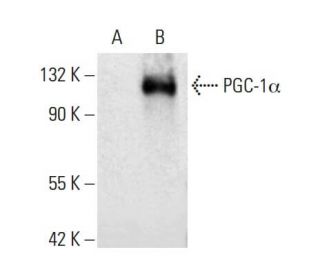
mouse monoclonal IgG2a; PGC-1α Antibody (D-5) is an IgG2a κ mouse monoclonal PGC-1 alpha antibody (also designated PPARGC1A antibody or PGC1A antibody) that detects the PGC-1 alpha protein of mouse, rat and human origin by WB, IP, IF, IHC(P) and ELISA. PGC-1α Antibody (D-5) is available as both the non-conjugated anti-PGC-1 alpha antibody form, as well as multiple conjugated forms of anti-PGC-1 alpha antibody, including agarose, HRP, PE, FITC and multiple Alexa Fluor® conjugates. Transcription factors exert their effects by associating with co-activator or corepressor proteins. The co-activator complexes are thought to be constitutively active, requiring only proper positioning in the genome to initiate transcription. Co-activators include the steroid receptor coactivator (SRC) and CREB binding protein (CBP) families that contain histone acetyltransferase (HAT) activity, which modifies chromatin structure. PPARgamma co-activator-1 (PGC-1) is a transcriptional cofactor of nuclear respiratory factor-1 (NRF-1), PPARbeta, PPARalpha and other nuclear receptors that is induced by exposure to cold temperatures and is involved in regulating thermogenic gene expression, protein uncoupling, and mitochondrial biogenesis. PGC-1 has a low inherent transcriptional activity when it is not bound to a transcription factor. Docking of PGC-1 to PPARgamma stimulates an apparent conformational change that then enables PGC-1 to bind to and assemble into complexes, which include the additional cofactors SRC-1 and CBP/p300, and results in a large increase in transcriptional activity.
DETAILS
- Host: mouse
- Uniprot: Q9UBK2
- Clonality: Monoclonal
- Conjugate: unconjugated
- Applications: WB, IP, IF, IHC(P), ELISA
- Human Gene Id: 10891
- Mouse Gene Id: 19017
- Protein Target: PGC-1α
- Human Gene Name: PPARGC1A
- Mouse Gene Name: Ppargc1a
- Species Reactivity: mouse, rat, human